Thursday, 6 December 2007

Photography


Photography was still in its relative infancy during the investigation of the Whitechapel murders.

Although the police used photography, it was only Mary Kelly who was actually photographed at the scene of the crime. The others were photographed once their bodies had been removed to the mortuary and cleaned up.

This was likely because the other 4 women were murdered in the street and the bodies were removed quickly to prevent the preying eyes of the public - which the use of the large camera would inevitably prevent.

Patricia Cornwell states:

Mortuary photographs were made with a big wooden box camera that could shoot only directly ahead… the camera could not be pointed down or at an angle.

Without the graphic and disturbing photographic evidence of the killer’s crimes, it is unlikely the mystery of the ‘Jack the Ripper’ would continue to fascinate people today.

Photographs from 'Casebook' website: http://photos.casebook.org/index.php?cat=19

Claire

Newspapers / Press


‘Jack the Ripper’s’ murders took place at a time when there was a lot of social change and immense growth within the press industry. The number of newspapers grew from a mere 14 to 168 papers throughout the UK – contributing to the publicity of the ‘Ripper’ murders.

Even at an early stage the newspapers were carrying theories as to the identity of the killer, including doctors, slaughterers, sailors, and lunatics of every description - fuelling the sensationalism of the murders.

Some papers became more popular. For instance ‘The Star’ really took off after its coverage of the crimes.

On September 4, 1888 - 4 days after the first murder of Polly Nichols - initial press reports of a ‘Ghastly Murder’ and a man named 'Leather Apron' appeared in the press

Each day newspapers chronicled the activities of the Ripper as well as inquiry results and actions taken by the police - according to the Ripper casebook it is reported that over 291 different newspapers throughout the world carried regular updates about the Whitechapel murders.

In the book ‘Jack the Ripper and the London Press’ author Perry Curtis suggests that “journalists played on the fears of readers about law and order by dwelling on lethal violence rather than sex, offering gruesome details about knife injuries but often withholding some of the more intimate details of the pelvic mutilations.” He also considers how the Ripper news affected public perceptions of social conditions in Whitechapel.

Even the feelings of the people living in the East End, and editorials that attacked the various establishments of Society appeared for both the people of London and the whole world to read.

Popular and lengthy inquests held on the victims by Coroner Wynne Baxter fuelled the press coverage to fever pitch – making the series of murders a ‘new thing’, something that the world had never known before and this could be argued as the beginning of “sensationalist” tabloid journalism.

The press was also partly responsible for creating many myths surrounding the Ripper and firmly established him as one of the most unlikely romantic figures in history.

Press reports from casebook: www.casebook.org/press_reports


Letters from Jack

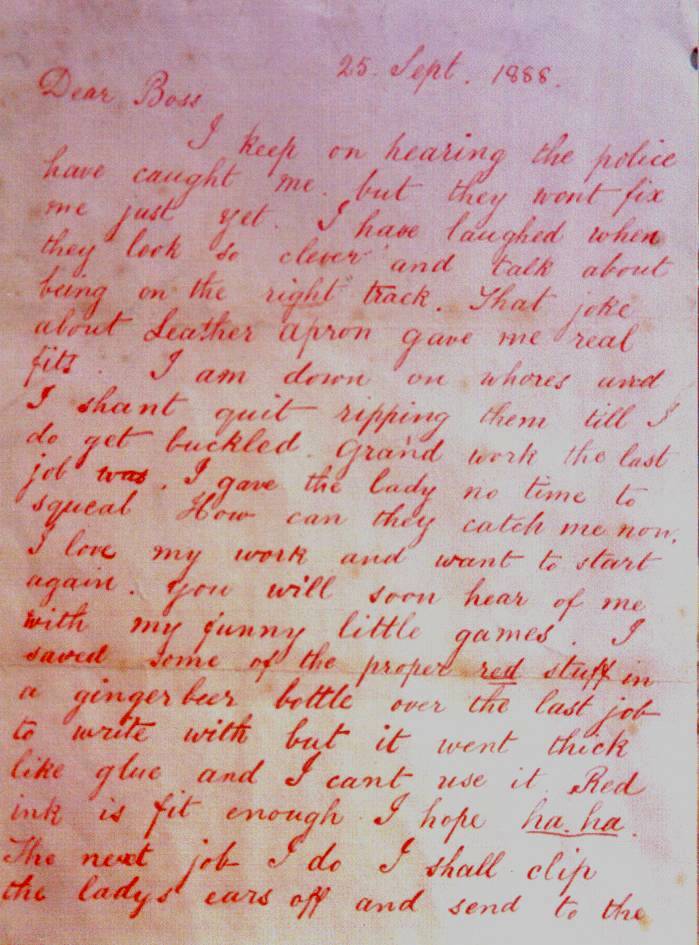
Throughout the time of the murders, police and the local press received 100s of letters.The name ‘Jack the Ripper’ was first signed in the ‘Dear Boss’ letter dated September 25 - written in red ink it was received on the 27 by the Central News agency, supposedly from the killer himself.

On October 1 1888, the morning issue of the Daily News first printed the text of the ‘Dear Boss’ letter.

The ‘Saucy Jack’ postcard marked October 1 followed. Also written in red ink and referring to both a "double event" and the first letter it was thought by police to have come from the same source.

It is possible the Whitechapel Murderer may have written them but there is no evidence and police seemed convinced they were the work of a London journalist.

Jack the Ripper letters from casebook: www.casebook.org/ripper_letters

Claire

Sunday, 2 December 2007

was jack the ripper an American doctor called Tumlety


unidentified suspect.

These were the four main recorderd suspects from the ripper case at metropolitan police history website.


In 1888, ex-Detective Chief lspector John George Littlechild. He confided his thoughts in a letter dated 23 September, 1913, to the criminological journalist and author George R Sims.


A documentry video called the 'white chapel murders', Potrayed inspecter Littlechild as a hero who revealed the name of the final and most suspected serial murderer of the east end murders.


The video speaks of the outstanding evidence linking Tumblety to the first and second murders.


He was a borgus doctor, who practiced back street abortions. He fitted, the identy of a man who decieved people through his charm and cunning manour.


For example, gold rings, clock, hat.


He was sited by his land lady to be wearing a bloody shirt and having disappeared a numerous of times after being arrested and released on bail.


The video explains, why it was okay for the police to cover up there mistakes arresting Tumblety and loosing him before there could charge him.


It is not conformed whether Tumblety was responsible for the murders, but history records him as the biggest suspect at the time.


  • Kosminski, a poor Polish Jew resident in Whitechapel;


  • Montague John Druitt, a 31 year old barrister and school teacher who committed suicide in December 1888;


  • Michael Ostrog, a Russian-born multi-pseudonymous thief and confidence trickster, believed to be 55 years old in 1888, and detained in asylums on several occasions;


  • Dr Francis J. Tumblety, 56 Years old, an American 'quack' doctor, who was arrested in November 1888 for offences of gross indecency, and fled the country later the same month, having obtained bail at a very high price.

Stuff For Presentation

Hey All,

This is what I was gonna say during the presentation, In the meeting tomorrow let me know how to shorten it as I think its to long at the moment

Slide 1
  • "The upper class would earn £30,000 where as the lower class would earn £25, however this was not guarenteed"
  • "The Gin Palace were a haven for the lowerclass compared to their homes"
  • And the contagious disease act was very gender and class bias

Slide 2

  • On average proffesional men and their families would live an extra 39 years than the lower class
  • "1000 less upperclass people died than the lower class in one year"
  • "The age of the Ripper victims were 44,48,45,46 and 25 respectivley"

Slide 3

  • "The Police force was established in 1829"
  • There was a lot of dicsiplinery problems with 238 men released in 1847"
  • "Springheeled Jack was a precursor to Jack the Ripper and like the Ripper the perpertrator was not discoverd"

Slide 4

  • "Division H was the White Chappel Division which is where the Ripper Killings took place"
  • "In 1857 there were 1803 Prostitutes in the H division"
  • In 1888 there were 548 Police officers in the H division.

Pictures of Living conditions in London in 1888

A picture of the work house in London in 1888

Catherine Eddowes

I chosen to focus on one of the Ripper victims Catherine Eddowes.This is due to the fact that Catherine Eddowes was not originally from London but Wolverhampton.This suggest that it was hard living in other parts of England not just the london's east end.Catherine was from a working class background as her father was a Tin plate worker and her mother had died quite early on.Her father George remarries whilst in london on a 'tinman' strike.He marries into a family of twelve children but the marriage is short lived as George dies soon after his new wife.

This suggests that Catherine would have been left with a lack of parental authority.Although she did have brothers and sister's they enter into Bermonsey work house in south London.This as a last result to getmoney for the basic food and shelter. So its is fair to suggest that Catherine Eddowes lived a life fighting for survival.Possibly why she ended up in London's East end.It is also fair to suggest that her death is also a result of the bad living conditions and the way in which the streets of East London were structured.Aparentlya night watch man stood in the same court yard in which Catherine Eddowes was dissected,yet failed to see her. http://www.casebook.org/victims/eddowes.html

Friday, 30 November 2007

Will the myth of the ripper ever end?


The ripper's identity is still unproven; however the name is still regarded with terror, by those who read into the history of London's east end.


The mystery has deepened, as time goes on, because the truth is obscure, due to facts being disturbed into stories, books, plays, films and musicals.

The truth has been less accepted than fiction stories of the ripper.


The name jack is easy to explain, at the time of Victorian Britain, and the word ripper was written along with 'Jack', at the end of a letter, dated on the 25Th September, 1888.

The letter was received by Central news agency, on the 27Th September, then sent to the police on the 29Th September.

The likely hood a the letter being written by central news or someone from the police, is very likely, although, all rippoliogists are aware of the letter ever existing, and can't help to think weather the letter was from the one and only 'jack the ripper'.


A quote from the letter connected the ripper, to the murders: 'i am down on the whores and i shan't quit ripping them till i do get buckled'.


The trade name 'jack the ripper', steamed form the letter and later released to the excited public by the press at the time, thus the creating imagination in pop culture.


Many facts from the investigation of the ripper, keep the myth alive, regardless of there connection with the true killer of the white chapel murders.

It is as though, all facts have to be interpreted the same for the myth to survive all these years, for example, the top hat and clock, and the apron

An image of a well dressed, middle aged man wearing a top hat, long clock, and a doctors bag comes to mind when one speaks of the ripper in Victorian Britain.


The story of the apron began when, someone found an apron in Goulston street after the murders of Catherin Eddowes o the 30TH September.

Written on the wall above the apron was message saying, 'the Jews are the men that will not be blamed for nothing'.


The myth spread within the Jewish, polish and the British residents of London's east end. But who was the ripper....i will post the answer to this question in then next blog.

Have a look at the photos i found on the metropolitan polices history.